Workers zone out. Supervisors rush through checklists. The same generic safety topic repeats every month. That’s the reality of most weekly toolbox talks—well-intentioned, poorly executed.
Effective toolbox talks don’t recite policies. They address real risks, spark conversation, and equip crews to act. Done right, they reduce incidents, reinforce culture, and keep compliance natural—not performative.
Here’s how to choose and deliver weekly toolbox talk topics that resonate, reduce risk, and build team accountability.
Why Most Toolbox Talks Fail (And How to Fix It)
Too many teams treat toolbox talks like a compliance box to tick. A supervisor reads from a PDF, hands out a sign-in sheet, and everyone returns to work—no discussion, no retention, no behavior change.
Common failures: - Generic content: “Slip, trip, and fall” with no site-specific context. - One-way delivery: No questions, no worker input. - Poor timing: Scheduled during shift change or in harsh weather. - Infrequent or irregular: Talks happen only when audited, not consistently.
Fix them by anchoring each session to real, current site conditions. If yesterday a worker nearly stepped into an open trench, that’s next week’s talk—not “electrical safety” recycled from a third-party template.
A 2023 NSC report found that teams using tailored, observational-based safety talks reduced near-misses by up to 42% compared to standard checklist formats.
Characteristics of High-Impact Toolbox Talk Topics
Not all topics drive change. The best ones share five traits:
- Relevance: Directly tied to current tasks, weather, equipment, or recent incidents.
- Specificity: Targets a single hazard or behavior, not broad categories.
- Actionable: Ends with clear steps workers can take.
- Interactive: Encourages questions, storytelling, or role-play.
- Timely: Delivered before the risk exposure, not after.
Example: Instead of “PPE Awareness,” try “Correct Respirator Fit Check Before Entering Confined Space—Today’s Tank Entry.”
The difference? Precision. Intent. Immediate application.
20 High-Value Weekly Toolbox Talk Topics (With Use Cases)
Rotate through these based on project phase, hazard exposure, and team feedback. Each can be delivered in 10–15 minutes.
- Ladder Safety During Roofing Work
- Use case: Crew installing shingles. Focus on three-point contact, ladder angle, and securing top/bottom.
- Heat Stress Signs and Hydration Breaks
- Use case: Summer concrete pours. Discuss early symptoms (dizziness, nausea), buddy checks, and shaded rest areas.
- Safe Use of Nail Guns with Sequential Triggers
- Use case: Framing team. Emphasize trigger types, point-of-fire control, and double-fire prevention.
- Overhead Power Line Awareness Near Excavators
- Use case: Utility trenching near power poles. Review minimum clearance (10 ft), spotter roles, and emergency shutdown.
- Working Alone in Remote Zones
- Use case: Surveyors or inspectors in isolated areas. Cover check-in protocols, emergency signaling, and communication devices.
- Cold Weather Glove Dexterity vs. Protection Trade-Off
- Use case: Winter steel erection. Test glove types for grip vs. warmth and discuss frostbite response.
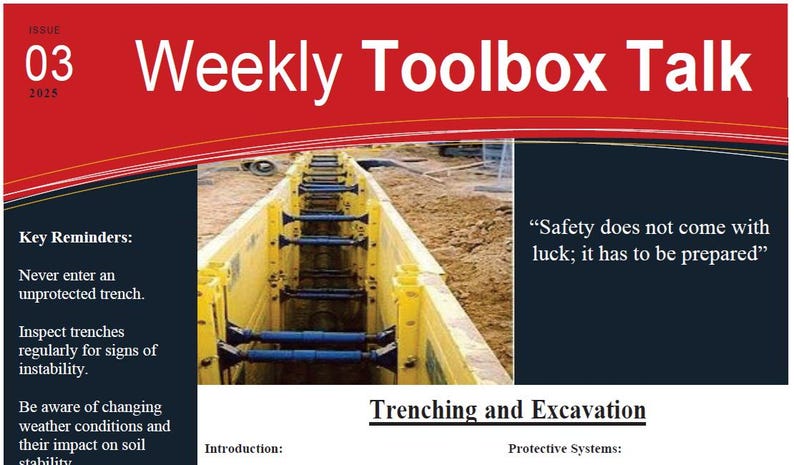
- Excavation Cave-In Recognition and Escape Routes
- Use case: Trench work deeper than 5 feet. Use soil type visuals and mark emergency ladders on site maps.
- Eye Protection for Grinding Operations
- Use case: Metal fabrication. Compare face shields vs. safety goggles and mandate both when needed.
- Hearing Conservation in High-Noise Zones
- Use case: Pile driving or jackhammering. Use decibel meter readings and enforce double protection (earmuffs + plugs).
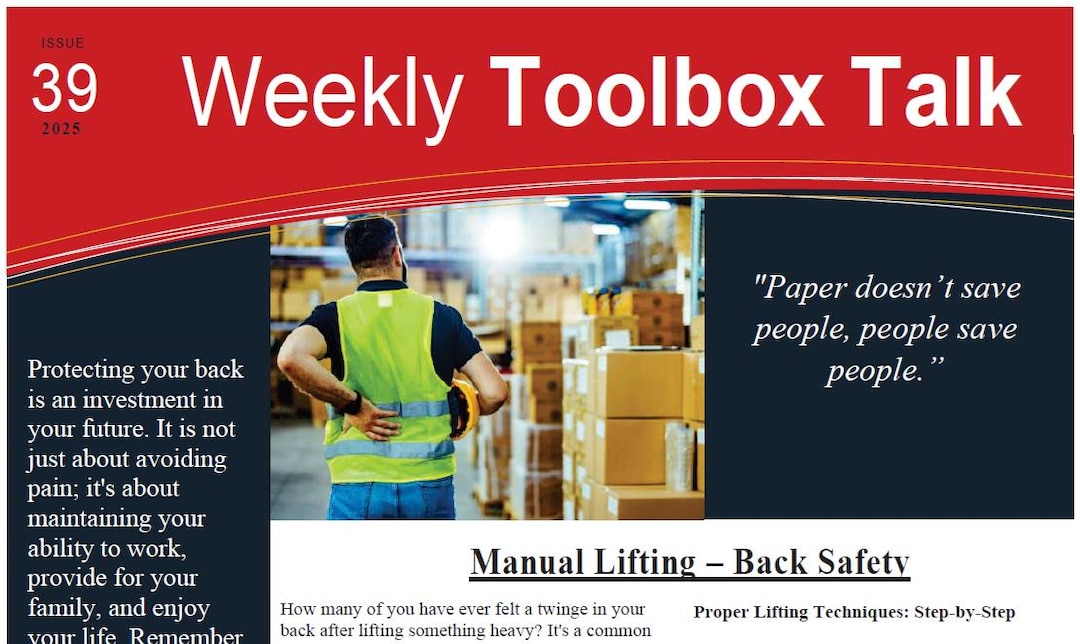
- Safe Lifting Techniques for Heavy HVAC Units
- Use case: Mechanical team. Demonstrate team lifts, load balance, and clear communication signals.
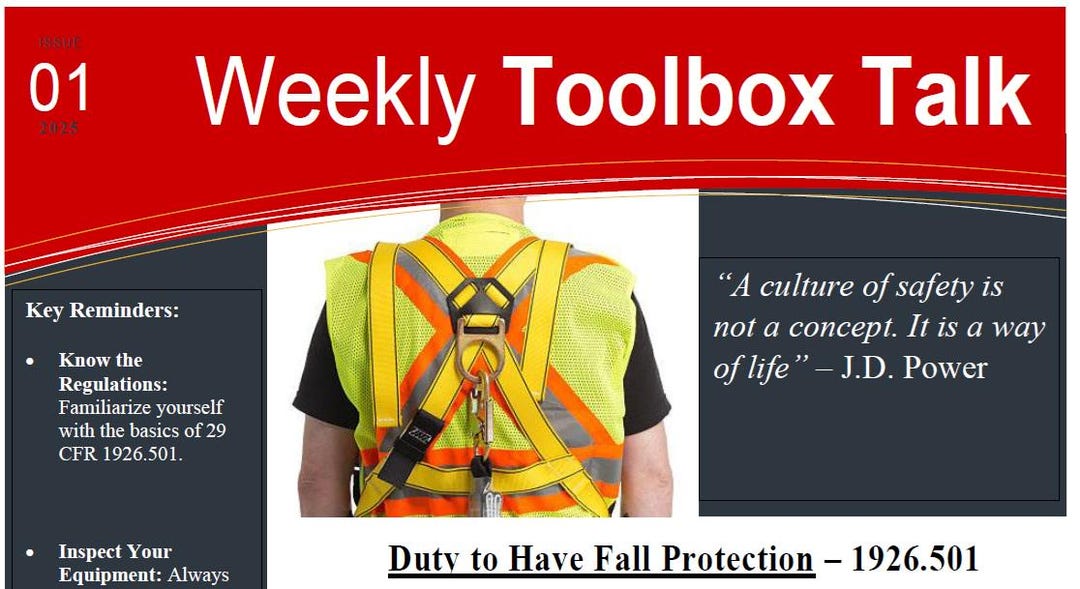
- Fall Protection Anchor Point Verification
- Use case: Rooftop solar install. Inspect anchor tags, load ratings, and connection sequence (strap first, then connect).
- Night Shift Visibility with Reflective Gear
- Use case: Roadwork crews. Test headlamps, verify ANSI Class 3 vests, and designate high-visibility zones.
- Chemical Spill Response for Solvent Use
- Use case: Painters using thinners. Walk through SDS access, spill kit locations, and containment steps.
- Hand Tool Inspection: Cracked Hammers, Worn Wrenches
- Use case: General maintenance. Pass around defective tools and show what “remove from service” looks like.
- Work Zone Traffic Control Setup
- Use case: Street repair. Review cone spacing, speed reduction signage, and flagger positioning.
- Confined Space Entry Communication Protocols
- Use case: Tank cleaning. Practice verbal check-ins every 10 minutes and simulate rope-pull signals.
- Scaffold Plank Overhang and Guardrail Integrity
- Use case: Exterior renovation. Measure overhang (6” max), check toe boards, and inspect couplers.
- Battery-Operated Tool Fire Risks (Lithium-ion)
- Use case: High-use cordless tools. Warn against punctured packs, charging overnight, and use of non-OEM chargers.
- Backover Prevention with Backup Alarms and Spotters
- Use case: Grading with dozers. Enforce spotter-to-operator hand signals and blind spot walks.
- Mental Fatigue and Situational Awareness
- Use case: Long-haul crews or overtime shifts. Normalize talking about focus loss and encourage peer check-ins.
Rotate these monthly, but adapt based on leading indicators—like a spike in near-misses or changing weather.
How to Structure a 10-Minute Toolbox Talk
Time is tight. Maximize impact with this flow:
- Hook (1 min): Start with a recent event.
- “Yesterday, a forklift clipped a scaffold post. No one was hurt—but what if someone was walking by?”
- Hazard Breakdown (3 min): Explain the risk, causes, and potential outcomes.
- Use a quick sketch or photo if available.
- Site-Specific Application (3 min):
- “On this pad, our forklift route crosses two footpaths. What controls do we have? Are they working?” Let workers speak. Encourage solutions.
- Action Step (2 min): Assign one clear behavior.
- “From now on, all forklift operators will perform a 360° walk-around before starting. Spotters will confirm path clearance.”
- Sign-Off (1 min): Review name, date, topic, and action on the sheet. Keep records for audits.
Avoid death-by-PowerPoint. Use whiteboards, real tools, or walk the hazard zone during the talk.
Integrating Worker Feedback Into Topic Selection
The best topics come from the field—not headquarters.
Use these methods to source ideas: - Near-miss reports: Turn each into a talk within 48 hours. - Crew leader huddles: Biweekly check-ins to identify emerging concerns. - Anonymous hazard dropbox: Digital or physical box for workers to submit risks. - Safety suggestion rewards: Incentivize contributions with gift cards or time off.
One electrical contractor reduced arc flash incidents by 60% after workers flagged damaged PPE during a talk. The next week’s session? “Inspecting Flame-Resistant Clothing for Wear and Tear.”
Bottom-up input builds ownership. Workers protect what they help create.
Common Mistakes to Avoid
Even experienced safety leads slip up. Watch for:
- Topic recycling: Repeating “PPE” every quarter without evolution.
- Blame-focused delivery: “You didn’t wear gloves” vs. “Why didn’t gloves work for you?”
- Ignoring non-routine tasks: One-off jobs (like rigging a crane) often lack prep talks.
- Skipping documentation: No record = no proof during OSHA inspections.
- Overloading: Covering three hazards in one session dilutes focus.
Fix by auditing your past 10 talks. How many would workers remember? How many changed behavior?
Tools to Streamline Weekly Toolbox Talk Planning
Save time without sacrificing quality. Use these digital or physical systems:
| Tool | Best For | Limitations |
|---|---|---|
| SafetyCulture (iAuditor) | Mobile talks, photo evidence, cloud storage | Subscription cost, learning curve |
| SiteDocs | Custom templates, real-time reporting | Requires reliable site internet |
| Microsoft Forms + SharePoint | Free, simple, integrates with Outlook | Manual follow-up needed |
| Printed Checklists (OSHA-based) | No tech required, field-tested | Hard to update, paper trail only |
| Notion Safety Hub Template | Collaborative planning, tagging, calendar sync | Requires team onboarding |
Pick one that fits your tech level and stick with it. Consistency beats complexity.
Closing: Make Every Talk a Behavior Catalyst
Weekly toolbox talks shouldn’t be routine. They should be relevant, responsive, and results-driven.
Stop reciting scripts. Start asking questions. Anchor each session to what’s happening right now on your site.
When a worker speaks up about a loose guardrail because last week’s talk covered machine safety—that’s success. That’s culture in motion.
Pick your next topic from yesterday’s near-miss, today’s weather, or a crew suggestion. Deliver it with clarity. Follow up.
Safety isn’t a meeting. It’s a conversation. Keep it going.
Frequently Asked Questions
What makes a good weekly toolbox talk topic? A good topic is specific, timely, and tied to current tasks or recent incidents. It prompts discussion and ends with a clear action step.
How long should a toolbox talk last? Ideally 10–15 minutes. Enough to explain the hazard, discuss site-specific risks, and agree on one behavioral change.
Can toolbox talks reduce accident rates? Yes—when they’re targeted and interactive. Studies show teams using consistent, relevant talks see up to a 40% drop in near-misses.
Should all workers attend every talk? Yes, but in shifts if needed. Attendance ensures shared understanding and accountability. Document participation for compliance.
How often should topics repeat? Critical topics (like fall protection) should reappear quarterly but with new examples. Avoid exact repeats—evolve the message.
Who should lead the weekly talk? Supervisors typically lead, but rotating crew members or safety reps increases engagement and diverse perspectives.
Can toolbox talks be recorded? Yes—via audio, video, or digital forms. Recording ensures documentation and allows remote or shift-based access.
FAQ
What should you look for in Weekly Toolbox Talk Topics That Actually Engage Teams? Focus on relevance, practical value, and how well the solution matches real user intent.
Is Weekly Toolbox Talk Topics That Actually Engage Teams suitable for beginners? That depends on the workflow, but a clear step-by-step approach usually makes it easier to start.
How do you compare options around Weekly Toolbox Talk Topics That Actually Engage Teams? Compare features, trust signals, limitations, pricing, and ease of implementation.
What mistakes should you avoid? Avoid generic choices, weak validation, and decisions based only on marketing claims.
What is the next best step? Shortlist the most relevant options, validate them quickly, and refine from real-world results.


:max_bytes(150000):strip_icc():focal(1039x225:1041x227)/King-Charles-III-and-Camilla-Queen-Consort-tout-112222-e1d9f3ad5fe54b0b8737ecf899b1da50.jpg)